






Over the years I’ve acquired a solid foundation of cooking techniques. From sautéing to broiling, I’m quite comfortable in the kitchen. One dish I can’t cook, however, is crème brûlée. I haven’t tested this hypothesis, but I have a feeling that my blowtorch skills are well below par. To me, crème brûlée is an oddity in the cooking world. It requires skills that aren’t commonly practiced and seems daunting at first glance.
Data sufficiency (DS) questions are the ‘crème brûlée’ of the GMAT. No other entrance examination includes data sufficiency questions or any derivative of them. When studying for quant, you’ll certainly need to review math concepts, but you shouldn’t have to learn how to answer problem solving (PS) questions. Unlike data sufficiency, you’ve been answering those sorts of questions in every math class you’ve taken. To excel at data sufficiency, however, you must rely on strategy.
Data sufficiency is different
Simply put, the DS section of the GMAT is different. It’s different because you aren’t trying to solve for one answer, like PS. Instead, your goal is to test for sufficiency. That means you’re trying to determine whether or not you’ve been provided enough information to definitively answer the question stem. Take this question stem, for example:
Is X > 9?
(1) X is Positive
(2) X - 2 = 11
To reiterate, you goal isn’t to solve for X, but to determine if the statements provided answer the question stem’s query. In this case, statement 1 is too vague: X could be any number greater than 0. Statement 2, however, tells us that when X is reduced by 2, it produces a number greater than 9. Therefore, statement 2 is sufficient.
Another quirk of DS is that every problem contains the same five answer choices. This should be intuitive: if your goal is proving sufficiency, how many different answers can there be? Something can’t be varying degrees of sufficient, right? Each problem offers two statements used to prove the question stem’s sufficiency. The answer choices mirror this objective:
a) Statement 1 ALONE is sufficient, but statement 2 alone is not sufficient to answer the question asked;
b) Statement 2 ALONE is sufficient, but statement 1 alone is not sufficient to answer the question asked;
c) BOTH statements 1 and 2 TOGETHER are sufficient to answer the question asked, but NEITHER statement ALONE is sufficient.
d) EACH statement ALONE is sufficient to answer the question asked;
e) Statements 1 and 2 TOGETHER are NOT sufficient to answer the question asked, and additional data specific to the problem are needed.
Because of its unique nature, DS can be a question type that test takers loathe. At its core, however, there are really only two reasons why you’d get a DS question wrong:
- You think you don’t have all of the information you need to prove sufficiency, but you do. Solution: Maximize the information you do have. Use the question stem, the other statement, simplifying with algebra, etc.
- You think you have all of the information you need to prove sufficiency, but you don’t. Solution: Be skeptical of the information you received and play devil’s advocate; if picking numbers, be sure to choose ones on both sides of the statement.
Despite what you might think at first, DS can actually be a refreshing change-of-pace from PS. Because you’re testing for sufficiency, not solving for one answer, DS problems can take less time to complete. Also, because the answer choices are always the same, DS is ripe with strategic opportunities – which we’ll discuss next.
GMAT tips: Basic strategy
If you ever hear an interview with a professional athlete about their superstitions, you’ll probably think they’re insane. Athletes obsess over the smallest of details: which shoe they tie first, what to eat before a game, and even where to sit on the team bus and/or plane. While this doesn’t convince the ‘Sports Gods’ to treat them favorably, it does give the athlete a sense of confidence and calm.
Following superstitions makes the athlete feel like they’re doing everything in their power to perform their best. This shouldn’t sound insane, however. Most people follow superstitions, also known as a routine, every day. Whether it’s eating a certain type of breakfast or remembering to pack an umbrella, routines are part of daily life. Again, while this doesn’t mean you’ll have a better life by doing so; routines do provide us with a sense of confidence and calm.
Eating lunch at a certain time each day might not provide you with any tangible benefits, but when approaching the GMAT DS problems, having a routine is extremely important and is the first of my GMAT tips for DS. Because DS is so strategically focused, more so than PS or the three verbal question types, and each question follows a similar pattern, approaching each problem the same way isn’t only possible, but it’s necessary to achieve a high score in quant.
When a DS problem comes up on the exam, before you even read the question, write down ‘AD / BCE’. This will help you keep track of your answers through the decision tree - which we’ll discuss later. Some guides recommend creating a grid before you begin the quant section.
If that’s your preference, feel free to do so. Otherwise, it can be easier to write ‘AD / BCE’ each time to not only engrain your routine, but so that you don’t have to keep flipping back through your scratch paper to find the grid.
After you’ve written down ‘AD / BCE’, read the question stem and ask yourself if it wants you to find the sufficiency of a specific ‘value’ or a ‘yes/no’ response. Depending on what’s asked, the definition of whether a statement is or isn’t sufficient could change.
- A value question will ask you for the exact value of something. If a statement narrows the possibilities down to exactly one number, not a range, it’s sufficient. Therefore, you’ll need to test at least two different numbers.
- A yes/no question will ask whether the question stem is or isn’t correct. For example, “Is X > 10?” Therefore, you should aim to find a yes and a ‘no’ outcome when testing for sufficiency.
Once you’ve determined what type of question you’re tasked with, your next step, and the next of my GMAT tips, is to simplify the question stem and statements. Doing so will make testing for sufficiency, either by algebra or by picking numbers, a much easier process. For example:
Is X >0?
(1) X2 = 9x
(2) X < Y
Focusing on statement 1, x2 = 9x can be simplified into X(X - 9) = 0. Therefore, X = 0, 9. Since there are two possible answers for X, statement 1 doesn’t sufficiently answer the question stem.
Assuming you understand the aim of the question stem and the provided information is simplified, your next step is to test for sufficiency, following the decision tree. The decision tree is, as follows, and begins with statement 1:
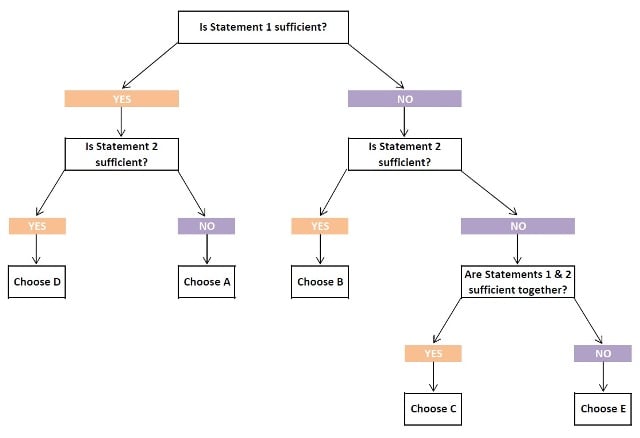
For the non-visual learner, your first test of sufficiency is statement 1. Depending on whether or not it’s sufficient, you test statement 2 individually and then the two statements together. Because these tests relate to each other, once you find out an individual statement’s sufficiency, you can immediately eliminate other answer choices.
Remember that AD / BCE grid? If statement 1 is sufficient, you can immediately cross off answer choices B, C, and E. You only have to test statement 2 to see if it’s also sufficient. If it is, the answer is D: both statements are individually sufficient. If not, then A is your answer: statement 1 alone is sufficient.
That’s your DS routine. In the next sections we’ll discuss how to test statements for sufficiency and some advanced strategy. To summarize:
1. Write down ‘AD / BCE’
2. Read the question stem
3. Simplify the question stem and statements 1 and 2
4. Follow the decision tree:
- Test statement 1
- Test statement 2
- Test both statements together (if applicable)
5. Choose answer and move to the next question




Get closer to your dream programme
Your consent preferences have been set.
Time to start exploring.
Your account has been removed.
You can still browse the site or sign up again once you have parental consent.
Get closer to your dream programme